What Are the Top Types of Wall Panels?
A Wall Panel can change how a room looks, sounds, and feels to the touch. The best choice depends on more than appearance. Think about moisture, cleaning, installation, budget, and the condition of the existing wall. A narrow hallway, for example, may benefit from durable, wipeable panels, while a home office might need better sound absorption. Small details matter.
This guide explores popular wall panel types, including wood, MDF, PVC, acoustic, textured, and stone-effect options. Each has practical strengths and limitations. Wood can bring warmth and visible grain, but its finish and upkeep deserve careful attention. PVC is often easy to clean, though its look may not suit every room. Acoustic panels can help soften sound, but they are not a substitute for proper soundproofing. Stone-effect panels offer a bold surface without the weight of solid masonry, yet quality varies between products. Not always. Before choosing, check the manufacturer’s installation instructions and suitability for the room, especially in damp areas. Samples can reveal color and texture differences that photographs hide. The most attractive option may be awkward to fit around sockets or uneven corners. That trade-off is worth considering. The sections ahead compare common styles, typical uses, and selection points, helping you match a panel to your space with clearer expectations.
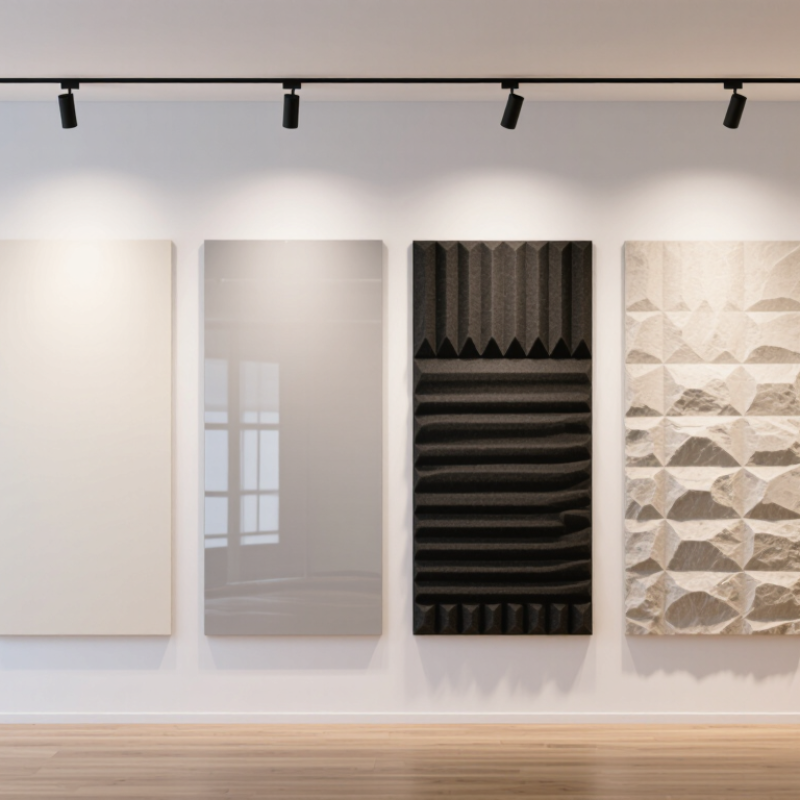
Wall Panels Explained: Five Material Families and Their Main Uses
Wall panels fall into five practical material families, each suited to different conditions. Gypsum board is common in interior partitions and ceilings, especially where tested fire-rated assemblies are required. The U.S. Geological Survey’s 2024 Mineral Commodity Summaries estimated U.S. gypsum mine production at about 22 million metric tons in 2023. That figure reflects supply, not wallboard demand, but it shows how established this material is.
Wood panels bring visible grain and warmth to feature walls, though humidity can cause movement. Small detail, big impact.
Polymer panels, including PVC, suit damp rooms because their surfaces are easy to wipe. Check fire ratings and expansion allowances before specifying them. Metal panels handle busy corridors and commercial interiors well; perforated versions can work with acoustic backing. Fabric-wrapped panels, often built around mineral fibre or polyester, absorb sound in offices and meeting rooms. They soften echoes, but they do not soundproof a room.
Selection depends on the whole assembly, not just the face material. Ask about cleaning, moisture exposure, impact resistance, fire performance, and replacement access. The U.S. Environmental Protection Agency estimated that construction and demolition activities generated about 600 million tons of debris in 2018. That broad total is not panel-specific, yet removable panels may make future repairs less wasteful. Not always. A durable finish can still be a poor choice if damaged sections cannot be replaced easily.
Gypsum Panels: ASTM C1396 and Common 1/2- and 5/8-Inch Boards
ASTM C1396 sets requirements for gypsum board, including dimensions, strength, and performance characteristics. It helps specifiers compare boards, but it does not rate a finished wall by itself. A wall’s fire or sound performance depends on the complete assembly, including framing, fasteners, joints, insulation, and installation.
Common 1/2-inch boards suit many interior walls where the framing and local requirements allow them. They are easier to carry and cut, though they can feel less rigid during installation. A 5/8-inch board is heavier and often appears in tested fire-resistance assemblies or where added stiffness is useful. Thickness alone does not make a wall fire-rated. That distinction is easy to miss.
On site, check the board markings and match them to the project specifications. A panel that meets ASTM C1396 may still be unsuitable for a damp location or a particular ceiling span. Confirm the assembly details, framing spacing, and fastener schedule before work begins. Small differences matter. I have seen crews treat two thicknesses as interchangeable; that shortcut can create extra work and may compromise the intended performance.
Wood and MDF Panels: Solid Timber, Veneer, and Engineered Options
Solid timber panels show genuine grain, knots, and color shifts, so each wall has a slightly different character. They can be sanded and refinished, but they respond to indoor humidity. The USDA Forest Products Laboratory’s Wood Handbook explains how moisture conditions affect wood dimensions. Leave suitable expansion gaps and acclimate boards before installation. The detail matters.
Veneer panels use a thin layer of real wood over a stable core, often MDF or plywood. They deliver a timber appearance with less solid wood, but the surface layer limits deep sanding. MDF offers a smooth face for paint and precise routed patterns, such as narrow flutes beside a doorway. Its edges need careful sealing, especially near sinks or damp rooms. The U.S. EPA’s TSCA Title VI limits formaldehyde emissions to 0.11 ppm for MDF and 0.13 ppm for thin MDF; check product documentation when comparing panels.
Material choice changes the result. Solid boards suit spaces where natural variation is welcome; veneer offers a more controlled grain; MDF makes crisp, repeatable profiles. Still, “stable” does not mean waterproof. I would not treat a painted MDF panel as a substitute for moisture protection. The USDA handbook’s humidity guidance is a useful reminder: room conditions can affect even well-installed woodwork.
PVC and Metal Panels: Comparing Moisture Performance and Surface Strength
PVC panels handle routine splashes well because the material does not absorb water. They suit laundry rooms, utility areas, and bathroom walls outside direct shower spray. Still, water can slip behind poorly sealed joints or collect around cut edges. That matters.
A neat surface does not guarantee a dry wall cavity.
Metal panels usually offer a firmer surface, but thin sheets can dent when struck by a hard object. Their moisture performance depends on the metal, finish, and installation details. A coated panel can resist humid air, yet a deep scratch may expose the layer beneath and invite corrosion. PVC is less likely to corrode, though it can scratch and soften near strong heat. I would not call either option foolproof. For a busy wash area, inspect panel seams, corners, and fasteners; those small details often decide how well the wall holds up over time.
Fiber-Cement Panels: ASTM C1186 Classifications for Interior and Exterior Use
Fiber-cement panels are classified under ASTM C1186 by intended exposure and flexural strength. Type A is intended for exterior use exposed to weather; Type B covers interior use and protected exterior applications. The standard defines four strength classes, I through IV, with increasing flexural performance. These labels help match a panel to its job, but they do not replace project-specific checks. (ASTM International, ASTM C1186-22.)
Read the product documentation carefully. A sheltered soffit and a rain-exposed wall face different moisture conditions, even when both use fiber cement. Check the specified type, class, thickness, and fastening requirements before installation. For example, a cut edge beside a window needs suitable detailing to limit water entry. Check edges. ASTM C1186 addresses sheet properties; it does not, by itself, establish fire resistance, impact performance, or a complete wall assembly’s weather-tightness. Those claims require separate evidence and compatible installation details. I would not choose a panel from its class alone: framing, joint design, and exposure can change how the finished wall performs.
What Are the Top Types of Wall Panels?
Fiber-Cement Panels: ASTM C1186 Classifications for Interior and Exterior Use
ASTM C1186 classifies flat fiber-cement sheets by intended use: Type A is for exterior applications exposed to weather, Type B is for exterior applications not exposed to weather, and Type C is for interior use. In this chart, 1 indicates the type’s intended-use category and 0 indicates it does not represent that category; these values are not performance ratings.