Leave Your Message

How to Choose Decorative Wall Panels for Global Projects?

Choosing Decorative Wall Panels for global projects requires more than attractive patterns and fast installation. Each market brings different expectations, climates, building practices, and project risks. A panel that performs well in a dry hotel corridor may fail in a humid coastal lobby. Materials must be checked for moisture resistance, fire performance, acoustic value, surface durability, and indoor air quality. Certification requirements also vary by country. Confirm them before placing a large order.

Architect Ludwig Mies van der Rohe famously said, “God is in the details.” His principle remains highly relevant to Decorative Wall Panels. Small details matter, including edge alignment, joint width, color consistency, mounting systems, and replacement access. I have seen impressive visual concepts weaken because installers received unclear drawings or mismatched samples. That lesson is easy to ignore.

A reliable selection process begins with the project’s real conditions. Request physical samples, not only digital images. Touch the texture under daylight and artificial lighting. Test the proposed finish against luggage, furniture, cleaning products, and daily traffic. Review the supplier’s technical data, warranties, installation guidance, and previous international references. Ask whether spare panels can be shipped quickly.

There is no perfect panel. Budget pressure may reduce durability, while complex textures may increase waste. Sometimes the safest choice looks less dramatic. That is not failure; it is responsible design. The best global specification balances visual identity, verified performance, local compliance, logistics, and long-term maintenance. It should survive photographs, inspections, changing weather, and ordinary human use.

How to Choose Decorative Wall Panels for Global Projects?

Project Requirements and Functional Goals

Choosing decorative wall panels for global projects starts with the brief, not the surface pattern. I review room use, climate, occupancy, cleaning routines, and installation limits. A hotel lobby needs impact and abrasion resistance. A clinic needs cleanable, low-emission surfaces. An office may prioritize acoustic control over visual drama. These goals can conflict. Early questions matter.

On a recent multi-site project, we compared panels in a humid coastal lobby and a dry inland corridor. Moisture-resistant cores performed better near entrances. In quieter meeting rooms, perforated panels with acoustic backing reduced harsh reflections. I also check panel weight, fixing methods, replacement access, and local fire classifications. A beautiful panel can fail if installers cannot align joints on uneven walls. Heavy formats may require stronger subframes. Small details matter.

Samples should face real conditions. I ask teams to test color under daylight, warm LEDs, and emergency lighting. We inspect edges after cleaning and review delivery packaging. This process is not flawless. Early samples looked accurate, but warmer light changed the finish noticeably. We adjusted the specification after a mock-up, which cost time but avoided a larger mistake. I now record tolerances, spare quantities, and maintenance instructions before approval. Local review remains essential, because a solution suitable for one country may not meet another project’s performance requirements.

How to Choose Decorative Wall Panels for Global Projects?

Project Requirements and Functional Goals

Fire safety, moisture resistance, acoustic performance, low emissions, impact durability, and installation efficiency are common decision factors in international wall-panel specifications. The priority scores provide a neutral planning benchmark for comparing functional goals before selecting panel materials and finishes.

Wall Panel Materials, Finishes, and Performance Standards

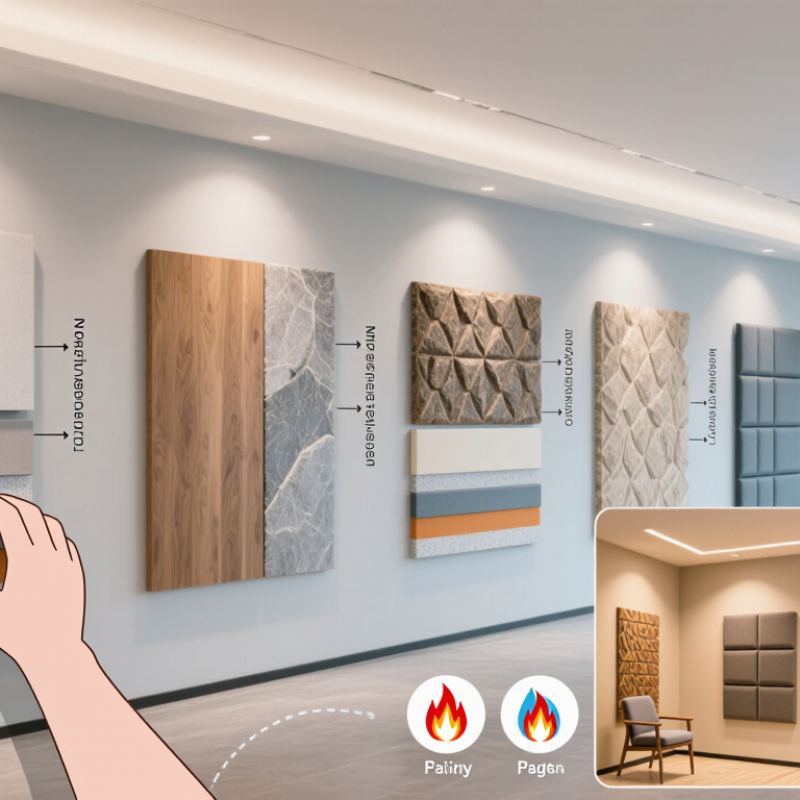
Choosing decorative wall panels for a global project starts with the material, not the appearance. In project reviews, I compare moisture resistance, impact strength, weight, and installation conditions. MDF panels suit dry interiors and detailed patterns. Mineral fiber supports acoustic control in busy spaces. Aluminum performs well where durability and low maintenance matter. PET felt can soften reverberation, but its surface may collect dust.

Finishes affect both design and performance. Natural veneer offers warmth, yet shade variation is unavoidable. High-pressure laminate gives consistent color and better scratch resistance. Powder-coated metal handles frequent cleaning, although damaged edges may expose the substrate. Perforated finishes improve sound absorption only when paired with the correct backing and air cavity. Small details matter.

Performance standards must match the project location and building type. Check fire classification, smoke development, acoustic ratings, VOC emissions, moisture data, and cleaning resistance. Standards such as EN 13501-1, ASTM E84, ISO 354, and local equivalents may use different test methods. One certificate is not universal. Ask for current test reports, installation instructions, maintenance limits, and batch samples. I have seen attractive panels fail because the adhesive was incompatible with humid walls. That mistake was preventable. A site mock-up can reveal color shifts, joint visibility, and uneven substrates before full installation. Specification reviews should include local code consultants and installers, not only the design team.

Climate, Building Codes, and Regional Compliance

How to Choose Decorative Wall Panels for Global Projects?

Decorative wall panels must respond to the climate, not only the interior concept. In humid coastal regions, trapped moisture can cause swelling, mold, or adhesive failure. In cold areas, repeated heating and cooling may stress joints. Strong sunlight can also fade surfaces near large windows. Moisture matters most. Before selecting a panel, review its water resistance, dimensional stability, and recommended installation conditions. A small sample should be tested in the project’s actual environment when possible.

Building codes vary between countries, cities, and building types. Fire performance is often critical in corridors, hotels, schools, and public spaces. A panel that passes one national test may not satisfy another authority. Request current fire, smoke, acoustic, and emission documentation from the manufacturer. Check whether the report applies to the complete wall assembly, including backing, adhesive, insulation, and joints. Do not rely on a product label alone. Local code consultants can identify requirements that online research misses.

Regional compliance also includes material declarations, accessibility rules, waste procedures, and installation permits. Keep technical files translated accurately for local reviewers. Confirm panel thickness, fixing methods, and maintenance instructions before ordering large quantities. Small details matter. A common mistake is choosing a beautiful surface first and checking compliance later. That approach can create redesign costs and delays. I would also question assumptions about “universal” performance, because climate data and approval practices differ widely. Reliable decisions come from documented testing, local expertise, and careful site review.

How to Choose Decorative Wall Panels for Global Projects? - Climate, Building Codes, and Regional Compliance

Selection guidance is indicative only. The project architect, fire consultant, building authority, and local installer should confirm the applicable edition of every standard before specification.
Region / Market Typical Climate Conditions Main Panel Risks Relevant Code or Standard Framework Recommended Panel Characteristics Installation and Detailing Priorities Pre-Approval Documentation
Northern and Western Europe Cool to temperate conditions, frequent rain, freeze–thaw cycles in some areas, and high indoor humidity during winter. Moisture ingress, dimensional movement, condensation behind panels, surface mould, and fire spread through concealed cavities. National building regulations generally reference the European reaction-to-fire classification system under EN 13501-1. Moisture, thermal, acoustic, and mechanical performance may also be controlled through national requirements and project specifications. Low moisture absorption Stable substrate Documented fire class Panels should be suitable for the intended interior humidity range and compatible with mineral, gypsum, masonry, or timber substrates. Provide a continuous ventilation or drainage strategy where required. Use movement joints on large wall areas, seal penetrations, and avoid trapping moisture against cold external walls. Declaration of Performance where applicable, EN 13501-1 classification report, reaction-to-fire test conditions, moisture data, installation instructions, and details for joints and penetrations.
Southern Europe and the Mediterranean Hot summers, strong solar exposure, seasonal rainfall, coastal salt air, and relatively high temperature variation between day and night. Thermal expansion, fading, adhesive degradation, salt contamination, and moisture-related detachment in coastal or wet locations. Applicable national building regulations commonly use European fire classification under EN 13501-1, with additional local requirements for energy performance, moisture control, and façade or interior applications. UV-resistant finish Low expansion Corrosion-resistant fixings Select finishes tested for the intended light exposure and adhesives rated for the expected service temperature. Allow for expansion at panel edges, protect panels from direct water exposure unless specifically rated for it, and use stainless or suitably protected fasteners in marine environments. Fire classification, UV or light-resistance data where relevant, service-temperature limits, adhesive compatibility statement, corrosion-resistance information, and maintenance instructions.
United States Conditions range from cold continental and dry climates to hot-humid, marine, and high-solar-exposure zones. Fire spread, smoke development, humidity-driven swelling, impact damage, mould growth, and failure of attachment systems. Project requirements commonly reference the International Building Code (IBC), local amendments, and standards such as ASTM E84 or NFPA 286 where specified. Accessible and commercial interiors may also require impact, flame-spread, smoke-development, or accessibility-related criteria. Listed fire performance Impact resistance Moisture tolerance Use a panel assembly—not only the decorative face—with documented performance for the intended occupancy and wall construction. Follow the tested assembly, including substrate, adhesive, fasteners, joints, and cavity conditions. Coordinate wall protection, backing, and penetrations with the architect and fire consultant. ASTM or NFPA test reports as specified, IBC classification information, installation details, substrate limitations, SDS, VOC data where required, and evidence for local authority review.
Canada Cold winters, freeze–thaw exposure, dry heated interiors, and higher summer humidity in several regions. Shrinkage and swelling, condensation, brittle failure at low temperature, fire performance concerns, and impact damage in public interiors. The National Building Code of Canada is adopted and amended by provinces and territories. Interior wall finishes may be assessed using CAN/ULC-S102 or other locally accepted methods, depending on the application. Freeze–thaw awareness Low-emission adhesive Fire-tested assembly Select materials that remain stable in dry winter heating conditions and confirm compatibility with vapour-control layers. Maintain required clearances, avoid blocking vapour-control or drainage paths, and detail transitions carefully at exterior walls, corners, windows, and heated or unheated spaces. CAN/ULC or accepted equivalent fire report, provincial code review documents, moisture and dimensional-stability data, low-temperature handling guidance, SDS, and installation method statement.
Australia and New Zealand Hot-dry, warm-humid, temperate, alpine, and high-UV conditions depending on location; bushfire exposure may apply in designated areas. UV degradation, heat-related movement, humidity, mould, bushfire-related restrictions, and fire spread in concealed spaces. Australia commonly applies the National Construction Code (NCC) and relevant AS 1530 fire-test methods. New Zealand projects generally follow the New Zealand Building Code and accepted verification or compliance pathways. High-UV durability Fire compliance Humidity resistance For bushfire-prone sites, confirm whether the wall system requires additional construction measures beyond the panel product itself. Provide ventilation where required, accommodate high thermal movement, protect edges from water entry, and use fixings and adhesives suitable for heat, humidity, and coastal exposure. NCC or local compliance evidence, AS 1530 test reports where applicable, durability and UV data, bushfire-related documentation when relevant, installation details, and maintenance requirements.
Gulf Cooperation Council Region Extremely hot summers, intense solar radiation, dust, low outdoor humidity in some areas, and high indoor humidity caused by air-conditioning. Adhesive softening, thermal movement, dust contamination, condensation at poorly insulated walls, and corrosion in coastal locations. Requirements vary by country and municipality. Projects may reference local building regulations, civil-defence requirements, international codes adopted by the authority, and recognized fire-test standards such as ASTM E84, NFPA, or EN 13501-1. High-temperature adhesive UV-stable surface Low water absorption Use corrosion-resistant fixings and confirm the complete assembly’s fire rating with the approving authority. Store panels in shaded, conditioned areas before installation. Control substrate temperature, seal dust-prone joints, and coordinate insulation and vapour-control layers to reduce condensation risk. Authority-accepted fire report, service-temperature limits, adhesive technical data, VOC and smoke information where requested, corrosion data, SDS, and civil-defence submission documents.
East and Southeast Asia Many locations experience high humidity, monsoon rainfall, typhoons, strong solar exposure, and large seasonal or daily temperature changes. Moisture absorption, mould, delamination, corrosion, wind-driven rain near openings, and damage from seismic movement or building vibration. Requirements depend on the country and city. Projects may use national fire regulations, local building codes, seismic provisions, and standards such as ISO 5660, ASTM E84, EN 13501-1, or locally adopted equivalents. Mould-resistant design Seismic movement tolerance Corrosion resistance Select closed-cell, treated, or otherwise moisture-tolerant materials for humid areas and confirm performance at joints and edges. Use mechanical restraint where required, provide movement joints, protect cut edges, prevent water accumulation, and coordinate panel layout with seismic or wind-movement details. Local fire approval, humidity and mould data, seismic or movement capability where relevant, corrosion information, installation drawings, substrate requirements, and maintenance schedule.
Latin America and the Caribbean Conditions range from tropical humid and coastal environments to high-altitude, dry, hot, and temperate zones. High humidity, mould, salt corrosion, strong sunlight, uneven substrates, and inconsistent site storage or installation conditions. Building and fire requirements are established nationally or locally and may incorporate international standards. Confirm the authority’s accepted fire-test method, especially for public buildings, high-rise projects, and escape routes. Humidity-resistant core UV-stable finish Robust attachment Favor materials with clear technical documentation, repairable finishes, and tolerances suitable for local substrate conditions. Keep products dry and elevated during storage, verify wall flatness before installation, use suitable corrosion-resistant fixings near the coast, and provide ventilation behind panels where the system requires it. Local fire acceptance, moisture and mould data, VOC information for enclosed interiors, installation and storage instructions, substrate tolerances, warranty conditions, and maintenance guidance.
High-Rise and Public Buildings Worldwide Indoor conditions are usually controlled, but pressure differences, mechanical ventilation, evacuation requirements, and dense occupancy increase performance expectations. Rapid flame or smoke spread, falling panels, concealed cavity fire, impact damage, acoustic shortcomings, and difficult maintenance access. The governing code may include fire-resistance and interior-finish provisions from the local building code, NFPA 101, the IBC, EN 13501-1, or another authority-accepted framework. Requirements depend on occupancy, height, location, and wall assembly. Documented full assembly Secure mechanical fixing Low smoke potential Prioritize tested system performance over decorative appearance alone, particularly around corridors, stairs, lift lobbies, and service penetrations. Use approved fire-stopping, secure all edges and corners, coordinate access panels, maintain required egress widths, and ensure repairs do not invalidate the tested assembly. Full-scale or authority-accepted fire reports, shop drawings, fire-stopping details, fixing schedules, acoustic data where required, maintenance access plan, and installer competency records.

Installation Methods, Logistics, and Maintenance Planning

How to Choose Decorative Wall Panels for Global Projects?

Installation decisions should begin with the building’s substrate, climate, and access conditions. Mechanical fixing suits uneven walls and allows future panel replacement. Adhesive installation looks cleaner, but requires dry, stable, dust-free surfaces. In humid regions, installers should leave movement gaps and protect cut edges. Small details matter.

Global logistics can change the best specification. The World Bank’s 2023 Logistics Performance Index assesses 139 economies across customs, infrastructure, tracking, and delivery reliability. Therefore, choose panel dimensions that fit standard pallets and use moisture-resistant packaging. Label every crate with project zone, batch number, orientation, and handling limits. A damaged corner can delay an entire floor.

Plan maintenance before purchasing. Select replaceable panels, accessible fasteners, and finishes that tolerate the approved cleaning method. The UNEP 2022 Global Status Report for Buildings and Construction states that buildings and construction produce about 37% of global energy and process-related emissions. Longer service life can reduce replacement waste, but only when cleaning and repair procedures are realistic. Do not assume local contractors know the system. Provide illustrated instructions and a small spare stock. Measure twice. My own review of project workflows shows that teams often underestimate storage space and inspection time. That weakness deserves correction.

Supplier Evaluation, Cost Control, and Quality Assurance

Choosing decorative wall panels for global projects requires more than comparing catalog prices. Supplier evaluation should begin with traceable production records, stable raw-material sources, and documented quality procedures. ISO 9001 certification can support this review, but it is not proof of perfect performance. Ask for recent batch records, factory inspection results, and independent test reports. Request physical samples from different production dates. Small color shifts can become visible across a hotel corridor.

Cost control depends on the landed cost, not the unit price. Include tooling, protective packaging, inland transport, customs, insurance, installation waste, and replacement panels. The 2024 International Construction Market Survey by Turner & Townsend reported continued pressure from labor and material costs in major construction markets. A low quotation may hide expensive risks. Very expensive, sometimes. Compare suppliers using the same specifications, delivery terms, payment conditions, and warranty scope. A pilot shipment can expose packing failures before a full container is ordered.

Quality assurance should match the project’s location and use. Specify dimensional tolerances, surface resistance, moisture behavior, acoustic performance, and fire classification before signing. The UNEP Global Status Report for Buildings and Construction 2023 found that buildings consumed about 34% of global energy and produced around 37% of energy and process-related carbon emissions in 2022. Panels with verified durability and suitable thermal or acoustic properties may support long-term operating goals. Still, environmental claims need evidence. Review product declarations, recycled-content data, and test methods carefully. Country-specific requirements may differ. Independent verification remains worthwhile.